Physical Address
304 North Cardinal St.
Dorchester Center, MA 02124
Physical Address
304 North Cardinal St.
Dorchester Center, MA 02124

Find Gear. Build Dreams. Game On.
Find Gear. Build Dreams. Game On.
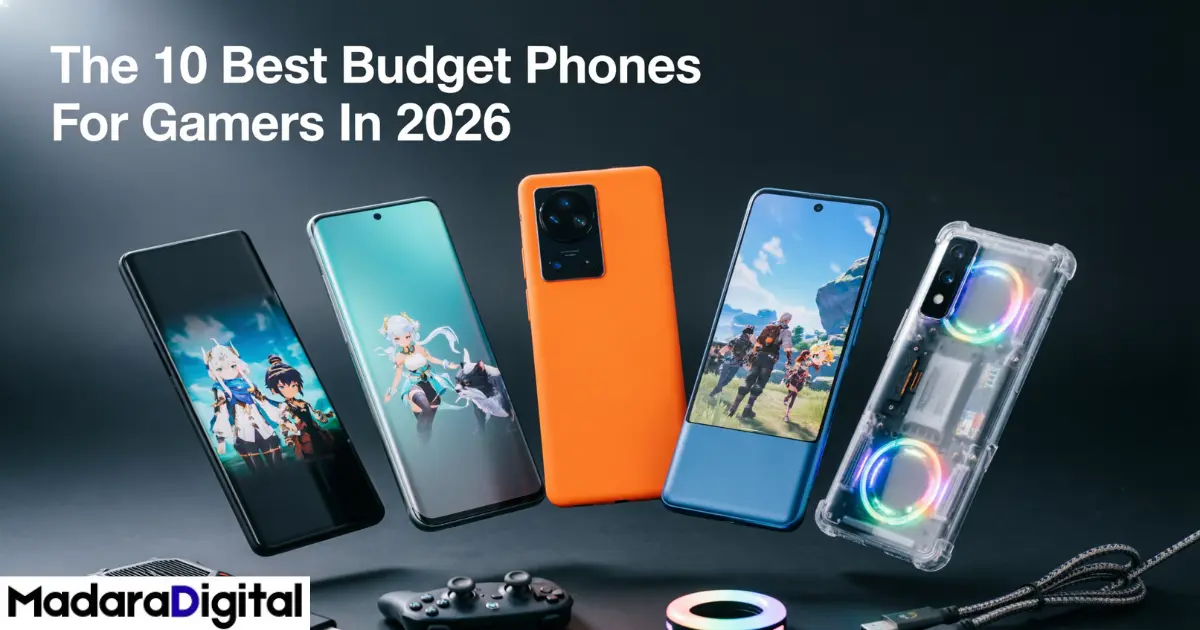
Powerful chipsets, buttery-smooth 120Hz+ displays, and marathon batteries — all under $600. These are the phones actually worth buying for PUBG Mobile, COD Mobile, Genshin Impact, and beyond.
Honestly, we’re living in a golden age for budget mobile gaming. I say this because a few years ago, spending under $400 meant you were basically stuck with 60fps, a mediocre chipset, and a battery that’d die mid-match. In 2026? That’s not the reality anymore. Not even close.
Right now, the best budget gaming phones 2026 have on offer are shipping with the Snapdragon 8 Elite — the same chip powering flagships that cost three times as much. You’ve got 144Hz AMOLED screens, 7,000mAh batteries, active cooling fans, and even hardware shoulder triggers, all sitting well under $600. The gap between budget and flagship gaming has genuinely never been smaller.
I’ve tracked every major release from early 2025 through this month and picked ten phones that I’d actually recommend to a friend — whether they’re grinding ranked PUBG, running long Genshin sessions, or just want a phone that handles heavy games without throttling into oblivion after 20 minutes. Here they are.

Before we get into the full breakdowns, here’s a quick comparison table so you can see the lineup side by side. I’ve ranked these by overall gaming value — performance, thermals, display, and battery, all taken into account.
| # | Phone | Price | Chipset | Display | Battery | Best For |
| 01 | RedMagic 11 Air | $499 | Snapdragon 8 Elite | 6.85″ AMOLED 144Hz | 7,000 mAh / 80W | Gaming King |
| 02 | Poco X7 Pro | ~$370 | Dimensity 8400 Ultra | 6.67″ AMOLED 120Hz | 6,000 mAh / 90W | Best Overall |
| 03 | Poco F7 | ~$380 | Snapdragon 8s Gen 4 | 6.83″ AMOLED 120Hz | 6,500 mAh / 90W | Value Flagship |
| 04 | Realme GT 7 Pro | ~$500 | Snapdragon 8 Elite | 6.78″ AMOLED 120Hz | 5,800 mAh / 120W | Fastest Charging |
| 05 | Nothing Phone (3a) | ~$379 | Snapdragon 7s Gen 3 | 6.77″ AMOLED 120Hz | 5,000 mAh / 50W | Best All-Rounder |
| 06 | Redmi Note 15 Pro 5G | ~$280 | Dimensity 8300 Ultra | 6.67″ AMOLED 120Hz | 6,580 mAh / 90W | Best Under $300 |
| 07 | OnePlus Nord CE 5 | ~$300 | Dimensity 8350 Apex | 6.77″ AMOLED 120Hz | 5,200 mAh / 80W | Cleanest Software |
| 08 | Samsung Galaxy A56 | ~$450 | Exynos 1580 | 6.7″ Super AMOLED 120Hz | 5,000 mAh / 45W | Best Samsung |
| 09 | Moto G Power (2026) | ~$300 | Snapdragon 6 Gen 3 | 6.7″ AMOLED 120Hz | 5,000 mAh / 68W | Casual Gamers |
| 10 | Infinix GT 20 Pro | ~$250 | Dimensity 8200 Ultimate | 6.78″ AMOLED 144Hz | 5,000 mAh / 45W | Budget Wildcard |
Alright, let’s get into the details. I’m breaking down each phone properly — what it’s actually like to game on, where it shines, and where it falls short. No sugarcoating.
| Specification | Details |
| Chipset | Snapdragon 8 Elite |
| RAM | 12GB / 16GB LPDDR5X |
| Display | 6.85″ AMOLED 144Hz, under-display camera |
| Battery | 7,000 mAh silicon-carbon |
| Charging | 80W wired (charger included) |
| Cooling | Active cooling fan + multi-layer vapor chamber |
| Gaming Features | 520Hz capacitive shoulder triggers, RGB lighting, RedCore R4 chip |
| Software | RedMagic OS 11, 2 Android updates + 3 years security |
| Price | $499 |
If you’re a serious mobile gamer, stop here. The RedMagic 11 Air is without question the most exciting budget gaming phone of 2026, and it’s not particularly close. At $499, you’re getting the full Snapdragon 8 Elite — not a “lite” version, not a binned chip, the actual flagship silicon that’s sitting inside $1,000+ phones. RedMagic pairs it with up to 16GB of LPDDR5X RAM, their proprietary RedCore R4 gaming chip, and the CUBE scheduling engine that pushes supported games to 144fps instead of the standard 60fps cap. In 3DMark’s Wild Life Stress Test, this phone literally returned “Maxed Out” because the benchmark couldn’t score it.
The 6.85-inch 144Hz AMOLED display is edge-to-edge because the selfie camera sits under the display — a genuine flex at this price. The 520Hz capacitive shoulder triggers on the sides are a legitimate game-changer for COD Mobile: map one to aim, one to fire, and suddenly you’re playing with something approaching a controller feel. An active cooling fan (returned after being absent from some earlier models), combined with a multi-layer vapor chamber, keeps thermals impressively stable during long sessions.
That 7,000mAh silicon-carbon battery is massive. Real-world testing shows 20+ hours of video playback, and in gaming use, you’ll comfortably get through a full day of heavy sessions. The 80W wired charging (with the charger included in the box, which is not always a given anymore) fills that enormous cell in around 68 minutes. The transparent glass back with aluminum rails looks premium — it’s a gaming phone with a gaming phone’s aesthetic: RGB lighting, bold lines, attitude.
The RedMagic Game Space software includes an AI Tactical Coach for shooters, Gemini integration, a built-in FPS counter, CPU temperature monitoring, and voice modulation for online play. Honestly, the software ecosystem here is purpose-built for gaming in a way that general Android phones just aren’t. Downsides: the camera system is decent but not special, no wireless charging, no eSIM. And with ASUS having exited the gaming phone market entirely in 2026, RedMagic is now one of the very last dedicated gaming phone brands standing, which gives them a moat and makes this phone even more interesting as a buy.
The software update promise is also worth noting: only two major Android updates and three years of security patches. If you’re planning to keep this phone for four-plus years, that’s a consideration. But if you’re a gamer who tends to upgrade every two years anyway, it’s a non-issue.
| Specification | Details |
| Chipset | MediaTek Dimensity 8400 Ultra (TSMC 4nm) |
| RAM | 8GB / 12GB LPDDR5X |
| Display | 6.67″ 1.5K AMOLED 120Hz, 2,560Hz touch sampling |
| Battery | 6,000 mAh silicon-carbon |
| Charging | 90W fast charging (100% in under 50 min) |
| Cooling | 3D IceLoop dual-channel liquid cooling |
| Gaming Features | WildBoost 3.0, HyperTouch, Game Turbo mode |
| Durability | IP68 / IP69 rating, Gorilla Glass 7i |
| Software | HyperOS 2 (Android 15), 3 Android updates |
| Price | ~$370 |
Ask me to pick one phone on this entire list to recommend to the average budget mobile gamer, and I’ll say the Poco X7 Pro without much hesitation. This thing is a genuinely remarkable package for around $370, and it’s one of the best-value gaming phones I can remember seeing at this price tier.
The MediaTek Dimensity 8400 Ultra chip is an all-big-core design built on TSMC’s 4nm process — it’s fast, power-efficient, and keeps sustained performance remarkably stable under load. Geekbench 6 multi-core scores sit around 6,100 points, which is in the same territory as 2024 flagships. In practice, that means PUBG Mobile at 90fps on Ultra settings without sweat, COD Mobile running silky smooth, and Genshin Impact holding a respectable 60fps until sustained extreme-settings sessions cause the usual slight thermal throttle (which happens on all phones, even flagships). WildBoost 3.0 uses machine learning to predict and preempt frame drops in real time, and HyperTouch’s 2,560Hz touch sampling in Game Turbo mode makes inputs feel sharp and responsive in ways that matter in competitive play.
The 3D IceLoop cooling system — Xiaomi’s largest-ever at the time of release — uses dual channels that separate liquid and vapor paths to prevent thermal buildup more effectively than traditional single-channel systems. After 30 minutes of Genshin Impact at max settings, the surface temperature stays manageable. That’s real for a sub-$400 phone.
The 1.5K AMOLED display is gorgeous — deeper blacks, punchy colors, Dolby Vision support, excellent outdoor brightness. The 6,000mAh silicon-carbon battery delivers genuine two-day battery life for moderate users, and 90W fast charging tops it back up from zero in under 50 minutes. The IP68 rating (IP69 in some markets) is almost unbelievably generous at this price — most budget phones top out at IP54. Gorilla Glass 7i protects the front. The Iron Man edition colorway exists, and it looks absolutely wild.
Where does it stumble? Cameras are decent, but not a reason to buy the phone. The 3.5mm headphone jack is gone — USB-C or Bluetooth only. Some pre-installed HyperOS bloatware requires a first-boot cleanup. Xiaomi promises three years of Android updates, which is adequate but not industry-leading. None of that touches the gaming experience, though.
| Specification | Details |
| Chipset | Snapdragon 8s Gen 4 (TSMC 4nm) |
| RAM | 12GB LPDDR5X |
| Display | 6.83″ 1.5K AMOLED 120Hz, 3,200 nits peak, 2,560Hz touch sampling |
| Battery | 6,500 mAh silicon-carbon |
| Charging | 90W HyperCharge (100% in ~45 min) |
| Cooling | 3D Dual-Channel IceLoop (largest in F-series) |
| Gaming Features | Game Turbo mode, instant touch sampling |
| Durability | IP68 rating, Gorilla Glass 7i |
| Software | HyperOS 2, 4 Android updates + 6 years security |
| Price | ~$380 |
The Poco F7 doesn’t get talked about as loudly as some of the other phones on this list, but it absolutely should. Launching mid-2025 and still sitting in excellent value territory heading into 2026, this phone is the quiet overachiever of the budget gaming segment — and arguably the best choice if you care about long-term software support alongside gaming performance.
The Snapdragon 8s Gen 4 inside is the key. While the “8s” label puts it in a tier below the full Snapdragon 8 Elite, in practice, it’s more than capable of handling any mobile game you throw at it with ease. The Adreno 825 GPU processes graphically intensive titles smoothly, and the TSMC 4nm build keeps efficiency strong. Poco’s IceLoop cooling system — their 3D dual-channel design — is the largest they’ve ever shipped in the F-series and does an excellent job preventing the kind of sustained throttling that kills long gaming sessions. The 2,560Hz instant touch sampling under Game Turbo mode keeps inputs feeling precise.
That 6,500mAh silicon-carbon battery is one of the best in its class — it’s the largest Poco has ever put in the F-series — and it’ll comfortably last through marathon gaming sessions and into the next day. The 90W HyperCharge brings it back from zero to full in around 45 minutes, which is superb. The 6.83-inch 1.5K AMOLED display looks spectacular for gaming: deep contrast ratio of 8,000,000:1, 3,200 nit peak brightness, Dolby Vision and HDR10+ support, and a Sony IMX882 camera with OIS for solid everyday photos.
Here’s where the Poco F7 really separates from the X7 Pro in one key area: software longevity. Xiaomi promises four major Android updates and six years of security patches for the F7, which is significantly better than the X7 Pro’s three-year commitment. If you’re the kind of person who holds onto a phone for four or five years, that matters a lot. The IP68 rating and Gorilla Glass 7i protection are present as well.
One caveat for US buyers: carrier compatibility is limited to T-Mobile, Mint, and Tello. If you’re on AT&T or Verizon, this phone won’t work on your network — so check that before buying. Global availability is fine; it’s specifically a US carrier restriction. Camera performance is solid in daylight but trails the Nothing Phone (3a) for everyday photos.
| Specification | Details |
| Chipset | Snapdragon 8 Elite |
| RAM | 12GB / 16GB LPDDR5X |
| Display | 6.78″ 1.5K LTPO AMOLED 120Hz, 6,000 nits peak, ultrasonic fingerprint |
| Battery | 5,800 mAh silicon-carbon |
| Charging | 120W SUPERVOOC (100% in ~30 min) |
| Cooling | Iceberg Dual VC (dual vapor chamber) |
| Gaming Features | LTPO adaptive refresh, flagship GPU performance |
| Durability | IP69 dust/water resistance |
| Software | Realme UI 6, 4 Android updates + 5 years security |
| Price | ~$500 |
The Realme GT 7 Pro is what happens when a brand genuinely stops caring about flagship price tiers and just stuffs their phone with the best hardware available. Announced in late 2024 and still very much one of the most relevant phones you can buy heading into 2026, this is a proper flagship killer in every sense — not just on paper, but in actual use.
The Snapdragon 8 Elite is the same chip that powers the Galaxy S26 Ultra (retailing at over $1,300) and the OnePlus 15 (around $900). In the GT 7 Pro, you’re getting that exact chipset for around $500. AnTuTu scores land above 2.1 million, and Geekbench 6 multi-core hits around 7,200 — there is no game in the Play Store that will challenge this phone. Genshin Impact, Star Rail, COD Mobile, PUBG Mobile, and Honkai Impact — all run at maximum settings without breaking a sweat.
Realme’s Iceberg Dual VC Cooling system uses a dual vapor chamber design to distribute heat across more surface area than single-chamber solutions. After 30 minutes of demanding gaming, surface temperature stays under 42°C — that’s impressive for a phone running a full flagship chip. The 6.78-inch LTPO AMOLED panel is one of the brightest displays under $600 at 6,000 nit peak brightness. LTPO means the refresh rate adaptively steps down to save battery when you’re not doing anything demanding, then jumps back up for gaming. Ultrasonic under-display fingerprint sensor — the same tech Samsung uses on the S25 series — makes it feel premium in use.
The 120W SUPERVOOC charging on the 5,800mAh silicon-carbon battery is the fastest on this entire list — it goes from zero to full in around 30 minutes. That’s game-changing if you forget to charge overnight. The triple Sony camera system, IP69 dust and water resistance (better than IP68), and 4+5 year update support all add genuine long-term value. Realme UI 6 is clean and lightweight with minimal bloatware.
The main thing holding this back from a higher ranking is the $500 price tag, which puts it at the top of what most people consider “budget,” and the slightly smaller 5,800mAh battery compared to some competitors. Wireless charging is absent as well. But for raw performance + fastest charging speed + IP69 protection in this price tier, nothing on this list touches it.
Abdo’s Verdict: If you want genuine flagship gaming performance and you never want to wait around for your phone to charge, the Realme GT 7 Pro is the pick. That 30-minute full charge is genuinely life-changing in daily gaming use.
| Specification | Details |
| Chipset | Snapdragon 7s Gen 3 |
| RAM | 8GB / 12GB |
| Display | 6.77″ AMOLED 120Hz, 1,000Hz touch sampling |
| Battery | 5,000 mAh |
| Charging | 50W wired |
| Cooling | Standard vapor chamber |
| Gaming Features | High touch sampling rate, clean OS for gaming |
| Camera | Triple camera with telephoto lens |
| Software | Nothing OS 4.0, 3 Android updates + 6 years security |
| Price | ~$379 |
The Nothing Phone (3a) is an unusual pick for a gaming-focused list because it was never marketed as a gaming phone. But that’s actually its strength. This is the phone you buy when you want a device that genuinely excels at gaming while also being exceptional at literally everything else — the all-rounder that doesn’t compromise.
The Snapdragon 7s Gen 3 powering it won’t win benchmark wars against the Dimensity 8400 Ultra or Snapdragon 8 Elite on this list, but it handles the games that matter — PUBG Mobile, COD Mobile, Genshin Impact at medium-to-high settings — comfortably and consistently. More importantly, the 1,000Hz touch sampling rate means your finger inputs are registered faster than on most mid-range competitors, which in fast-paced shooters can make a real difference. The 6.77-inch 120Hz AMOLED display is vibrant and responsive, with the excellent color accuracy that Nothing’s panels are known for.
Where Nothing really wins is everything around the gaming experience. Nothing OS 4.0 is one of the cleanest Android experiences available in 2026 — no bloatware, no aggressive AI features you didn’t ask for, fast monthly security updates, and a design language that feels genuinely considered and intentional. The Glyph Interface on the back isn’t just aesthetic gimmickry; it has functional uses for notifications and charging indicators that make daily life more convenient. The triple camera system includes a proper telephoto lens, which is remarkably rare under $400, and makes this a genuinely capable all-day photography phone. Six years of security patches means this phone will stay supported until 2031.
The 5,000mAh battery gets through a full day of heavy gaming without problems, and 50W charging is decent if not the fastest on this list. The one persistent frustration for US buyers is availability — Nothing still requires going through their beta program to purchase in the States, which adds unnecessary friction. But if you can navigate that, you’re getting one of the most refined smartphone experiences available at this price.
Abdo’s Verdict: If you want a phone that handles gaming well AND is your go-to for camera, daily life, and software experience — without looking like a gaming phone — the Nothing Phone (3a) is the move. Best balanced budget phone in 2026.
| Specification | Details |
| Chipset | MediaTek Dimensity 8300 Ultra |
| RAM | 8GB / 12GB LPDDR5X |
| Display | 6.67″ AMOLED 120Hz |
| Battery | 6,580 mAh silicon-carbon |
| Charging | 90W HyperCharge (100% in under 50 min) |
| Cooling | Vapor chamber cooling |
| Gaming Features | HyperOS 2 gaming optimizations |
| Camera | 200MP main camera |
| Software | HyperOS 2 (Android 15) |
| Price | ~$280 |
This is the one I’d hand to anyone who’s got a hard $300 ceiling and still wants genuine gaming performance. The Redmi Note 15 Pro 5G is one of the most hardware-packed phones under $300 on the market right now, and in 2026, it’s become something of a benchmark for what budget phones should be offering.
The MediaTek Dimensity 8300 Ultra is a capable chip — the same class that was powering near-flagship devices a year or two ago. It handles PUBG Mobile comfortably at high settings, runs COD Mobile without meaningful frame drops, and manages Genshin Impact at medium graphics with a reasonable framerate. With up to 12GB of LPDDR5X RAM, multitasking is smooth, and app switching stays fast. HyperOS 2 brings some handy gaming optimizations, and the 120Hz AMOLED panel gives you the visual smoothness you need for competitive play.
The real standout feature is that 6,580mAh silicon-carbon battery — one of the largest cells in any sub-$300 phone in 2026. Silicon-carbon chemistry, which was reserved for premium phones not long ago, gives it better energy density and improved long-term battery health compared to older lithium-ion cells. In practice, this phone comfortably lasts two days on moderate use. And if you drain it during a long gaming session, the 90W fast charging gets you back to 100% in under 50 minutes. For a gamer, that combination of a big battery and fast charging is almost ideal.
The 200MP main camera sounds like marketing fluff (and it partly is — pixel binning means you’re getting effective 12.5MP shots most of the time), but in good lighting, the results are genuinely solid for the price. Where the phone falls short is software longevity — Xiaomi’s update commitment here is shorter than Samsung’s or Google’s at this price, and there’s the usual first-boot bloatware cleanup required. For a gaming-first purchase, though, these are minor issues.
Abdo’s Verdict: The undisputed best value under $300 for gamers. Enormous battery, fast charging, capable chip, 120Hz AMOLED — you genuinely won’t find a better gaming setup for less money right now.
| Specification | Details |
| Chipset | MediaTek Dimensity 8350 Apex |
| RAM | 8GB / 12GB |
| Display | 6.77″ AMOLED 120Hz |
| Battery | 5,200 mAh |
| Charging | 80W fast charging (50% in under 20 min) |
| Cooling | Advanced vapor chamber for sustained gaming |
| Gaming Features | Sustained performance focus, minimal throttling |
| Software | OxygenOS 15 (Android 15), 3 Android updates + 6 years security |
| Price | ~$300 |
OnePlus has always had a loyal following, and for good reason. They just consistently make solid phones. The Nord CE 5 is another example of that — nothing flashy, no gimmicks, but excellent sustained gaming performance, a clean software experience, and long update support all packaged at around $300.
The Dimensity 8350 Apex chip has been highlighted by multiple tech publications as one of the best sustained gaming chipsets in the sub-$300 tier — not just for peak performance, but for maintaining consistent frame rates during extended sessions without significant throttling. That’s the part that matters most for competitive gaming: you don’t want a phone that hits 90fps for five minutes and then drops to 45fps when it heats up. The Nord CE 5 holds its line better than many competitors here.
OxygenOS 15 is genuinely excellent software — one of the cleanest and most refined Android skins available at any price. No excessive bloatware, no AI features shoved in your face, just fast and logical Android with some smart OnePlus customizations. The three years of Android updates plus six years of security patches also make this one of the better long-term bets at the $300 mark. The 6.77-inch 120Hz AMOLED display is responsive and vibrant, and the 80W fast charging gets the 5,200mAh cell topped up efficiently — 50% in under 20 minutes is genuinely useful for a quick charge between sessions.
Honestly, the Nord CE 5 isn’t the most exciting phone on this list. It doesn’t have the ridiculous specs of the RedMagic, the massive battery of the Redmi Note, or the cool factor of the Nothing Phone. What it does have is reliable, consistent performance with excellent software and real update longevity, which is exactly what a lot of gamers actually need day-to-day. Some user reports flag occasional inconsistency hitting 90fps in PUBG Mobile specifically, so that’s worth knowing.
| Specification | Details |
| Chipset | Exynos 1580 |
| RAM | 8GB / 12GB |
| Display | 6.7″ Super AMOLED 120Hz |
| Battery | 5,000 mAh |
| Charging | 45W wired |
| Cooling | Vapor chamber cooling |
| Gaming Features | Bypass Charging (power directly to processor), Game Booster |
| Durability | IP67 rating, Gorilla Glass Victus+ |
| Software | One UI 7, 4 Android updates + 6 years security |
| Price | ~$450 |
I want to be honest with you about the Samsung Galaxy A56: it’s not a pure gaming phone. If you’re looking purely for gaming performance, several phones on this list at lower prices will outperform it. But if you want the best all-round Samsung experience — great build quality, excellent display, trusted software, class-leading update support — while still being able to run most mobile games adequately, the A56 earns its spot.
The Exynos 1580 chip is a significant improvement over the Exynos 1480 in the A55 — better efficiency, better sustained performance, no longer plagued by the overheating issues that dogged earlier Exynos generations. For everyday gaming — PUBG Mobile, COD Mobile, Clash Royale, casual titles — the A56 runs well and feels snappy. Where it struggles is in genuinely demanding titles: reviewers who tested Fortnite Mobile noted choppy performance even at low settings, and Genshin Impact at max settings causes frame drops and frustration. The AnTuTu score of around 841,000 is solid for daily use but trails the Dimensity 8400 Ultra significantly for heavy gaming workloads.
What the A56 does exceptionally well: the 6.7-inch Super AMOLED display is genuinely gorgeous — Samsung knows displays like no one else, and this one is bright, colorful, and fluid at 120Hz. Gorilla Glass Victus+ on both front and back gives it premium durability. IP67 water resistance. Dolby Atmos stereo speakers. Four years of Android updates and six years of security patches make this one of the most future-proofed mid-range phones you can buy, period. Samsung’s One UI 7 is polished and feature-rich, and the Bypass Charging feature (which routes power directly from the charger to the processor during gaming, bypassing the battery to reduce heat) is a genuinely smart gaming-focused addition.
At around $450, it’s not the cheapest option on this list, and the cameras — while fine for everyday shots — won’t blow you away. If Samsung’s ecosystem, brand reliability, and six years of guaranteed updates matter to you as much as gaming specs, this is the pick. For pure gaming performance per dollar, look above this in the list.
Abdo’s Verdict: The best option if you want a Samsung and you do moderate gaming. Exceptional display, best-in-class update support, and a genuinely premium feel. Just don’t expect to run Fortnite at high settings.
| Specification | Details |
| Chipset | Snapdragon 6 Gen 3 |
| RAM | 8GB |
| Display | 6.7″ AMOLED 120Hz |
| Battery | 5,000 mAh |
| Charging | 68W wired + 15W wireless (charger included) |
| Cooling | Standard cooling |
| Gaming Features | Clean Android for gaming, casual gaming focus |
| Software | Near-stock Android 15, 2 Android updates + 3 years security |
| Price | ~$300 |
The Moto G Power 2026 is the underdog of this list, and I’m totally fine with that. It’s not here because it’s the most powerful gaming phone under $300 — it clearly isn’t. It’s here because it offers the most well-rounded everyday experience for casual and mid-core mobile gamers who want a reliable, feature-packed phone that happens to handle games well.
The Snapdragon 6 Gen 3 is a capable everyday chip. Popular titles like PUBG Mobile and COD Mobile run at medium settings with consistent framerates, and lighter games run with no issues whatsoever. For casual players grinding daily missions, playing battle royale occasionally, or enjoying MOBAs and RPGs, this is more than enough. Where it’s not going to impress is in demanding 3D titles at maximum settings — Genshin Impact at high graphics is a stretch, and you’ll want to manage expectations there.
What makes the Moto G Power genuinely stand out at $300 is the features that competitors don’t bother including at this price. Wireless charging at 15W is extraordinarily rare below $400 — and Motorola includes a 15W wireless charger in the box, which adds real-world value that spec sheets don’t capture. The 68W wired fast charging is impressive for a midrange phone, and the 5,000mAh battery delivers two days of battery life for regular users. The 6.7-inch 120Hz AMOLED display actually tests well for brightness and clarity in reviews — notably better than you’d expect for the price.
Motorola runs near-stock Android with minimal bloatware — a genuinely pleasant experience day to day. Build quality feels premium enough, and the overall package is polished. The main downsides: only two years of Android updates and three years of security patches (well below the competition), and the chip ceiling means heavy gamers will hit its limits. Motorola has also committed to including the charger in the box, which sounds like a small thing until you remember that most phone makers stopped doing this.
Abdo’s Verdict: Perfect for the casual mobile gamer who wants wireless charging, clean software, and great battery life at $300. Don’t buy it for competitive Genshin sessions — do buy it if you want a fuss-free gaming phone for everyday play.
| Specification | Details |
| Chipset | MediaTek Dimensity 8200 Ultimate |
| RAM | 12GB LPDDR5 |
| Storage | 256GB UFS 3.1 |
| Display | 6.78″ AMOLED 144Hz |
| Battery | 5,000 mAh |
| Charging | 45W wired |
| Cooling | GT Turbo cooling (graphene thermal pad + vapor chamber) |
| Gaming Features | 144Hz refresh rate, gaming-focused software suite, performance profiles |
| Software | XOS (based on Android), inconsistent update schedule |
| Price | ~$250 |
The Infinix GT 20 Pro is here because it represents something genuinely interesting in 2026: a phone that’s specifically designed and marketed for gaming, priced at around $250, and actually delivers on that promise for the most part. It’s the wildcard of the list — not as polished as the phones above it, but if your budget ceiling is $250 and gaming is your priority, this is where you end up.
The Dimensity 8200 Ultimate chip is a reliable performer at this price tier — capable of handling PUBG Mobile, COD Mobile, and most mid-core titles at good settings with consistent frame rates. It’s not going to compete with the Dimensity 8400 Ultra or Snapdragon 8 Elite phones above it, but within the sub-$260 segment, it’s competitive. Infinix ships it with 12GB of LPDDR5 RAM standard, which is genuinely unusual at this price and helps with multitasking and keeping games loaded in memory.
The real highlight is the 6.78-inch 144Hz AMOLED display. Finding a 144Hz AMOLED panel at $250 is legitimately impressive — most phones at this price top out at 90Hz or offer 120Hz on IPS LCD panels. The higher refresh rate makes gaming noticeably smoother and is a genuine competitive advantage in fast-paced shooters. Infinix’s GT Turbo cooling system uses a graphene thermal pad and vapor chamber to keep temperatures manageable during gaming sessions, and the gaming-focused software suite includes performance profiles and touch optimization settings.
Where the GT 20 Pro falls short is in the overall refinement of the experience. Software updates are inconsistent, and the long-term support promise is vague. The 45W charging is adequate but far from the fastest on this list. Camera performance is solid for the price, but won’t impress. Build quality and overall software polish trail the more established brands significantly. Infinix is also less widely available in North America and Europe compared to Xiaomi, Samsung, or OnePlus — so check availability in your region first.
Related Articles:
Top 20 Best Gaming Phones of 2026: Ultimate Ranking
Boost Gaming Performance on Android (2026)
Best Game Booster Apps for Android in 2025 (Tested & Ranked)
30 Best Android Game Booster Apps That Actually Work (2026)
With so many affordable gaming smartphones in 2026 hitting the market every month, it’s easy to get overwhelmed by spec sheets. Here’s what I actually look at when evaluating a budget phone for PUBG, COD Mobile, and heavy gaming.
The processor determines your gaming ceiling — everything else is secondary. In 2026, aim for at least a Dimensity 8000-series chip or Snapdragon 7s Gen 3 for mid-core gaming, and look for Dimensity 8400 Ultra, Snapdragon 8s Gen 4, or Snapdragon 8 Elite if you want to run the most demanding titles at high settings. AnTuTu scores above 700,000 put you in comfortable gaming territory; above 1.5 million and you’re approaching flagship territory.
Here’s something benchmark charts don’t show you: a phone that hits a stunning AnTuTu score but throttles to 60% performance after 10 minutes of gaming is worse than a phone that scores slightly lower but stays stable for two hours. Always look for vapor chamber cooling, large heat-dissipation areas, and real-world sustained performance data. The IceLoop systems in Poco phones and the Iceberg Dual VC in the Realme GT 7 Pro are strong examples of what good thermal management looks like at budget prices.
120Hz is the minimum for gaming in 2026 — anything lower will feel noticeably sluggish. But don’t overlook touch sampling rate, which is how quickly the screen registers your input. Standard is 240Hz; gaming phones often push 480Hz or 1,000Hz+ in gaming mode. In fast-twitch shooters like COD Mobile, the difference between 240Hz and 1,000Hz touch sampling is real and measurable in competitive play.
Quick Tip
Silicon-carbon batteries are quietly one of the biggest stories in budget phones right now. They’re filtering down from flagship pricing and appearing in phones well under $300. They offer higher energy density (bigger effective capacity in the same physical size) and better long-term cell health than traditional lithium-ion. If two phones are close on specs, pick the one with a silicon-carbon battery — your battery life two years from now will thank you.
This is the one factor most gaming-focused buyers ignore and then regret two years later. A phone with three years of OS updates will become noticeably slower and less secure by year four. Samsung (6 years), Nothing (3 Android + 6 security), and Poco F7 (4 Android + 6 security) lead the pack here. If you’re planning to keep your phone for a long time, weigh this heavily.
2026 is genuinely a great time to be a budget mobile gamer. The RedMagic 11 Air alone would have been a mid-range-to-flagship product just three years ago — and now it’s sitting at $499 with a full Snapdragon 8 Elite, a 7,000mAh battery, and 144Hz shoulder triggers. The Poco X7 Pro offers flagship-level thermals and a silicon-carbon battery for $370. Even the $250 Infinix GT 20 Pro ships with a 144Hz AMOLED panel and 12GB of RAM. The value in this segment right now is staggering.
In my opinion, if you can stretch to $370–$499, the RedMagic 11 Air is the best dedicated gaming phone on this list, and the Poco X7 Pro is the best overall value. If you’re under $300, the Redmi Note 15 Pro 5G is where I’d put my money. And if you want a Samsung specifically, the Galaxy A56 is the one to buy — just go in knowing it’s a casual gamer’s phone, not a competitive gaming beast.
Whatever you pick from this list, you’re going to be able to run PUBG, COD Mobile, and the most popular titles without fighting your phone. That’s the win. No more mid-match battery deaths, overheating screens, or laggy input — just clean gameplay on a phone that actually respects what you’re trying to do.
What’s on your radar right now — are you leaning toward the RedMagic for the gaming features, or does the Poco X7 Pro’s value make more sense for you? Or maybe there’s a phone I missed that you think deserves a spot on this list? Drop your thoughts in the comments — I’d genuinely love to hear what you guys are gaming on this year.