Physical Address
304 North Cardinal St.
Dorchester Center, MA 02124
Physical Address
304 North Cardinal St.
Dorchester Center, MA 02124

Find Gear. Build Dreams. Game On.
Find Gear. Build Dreams. Game On.
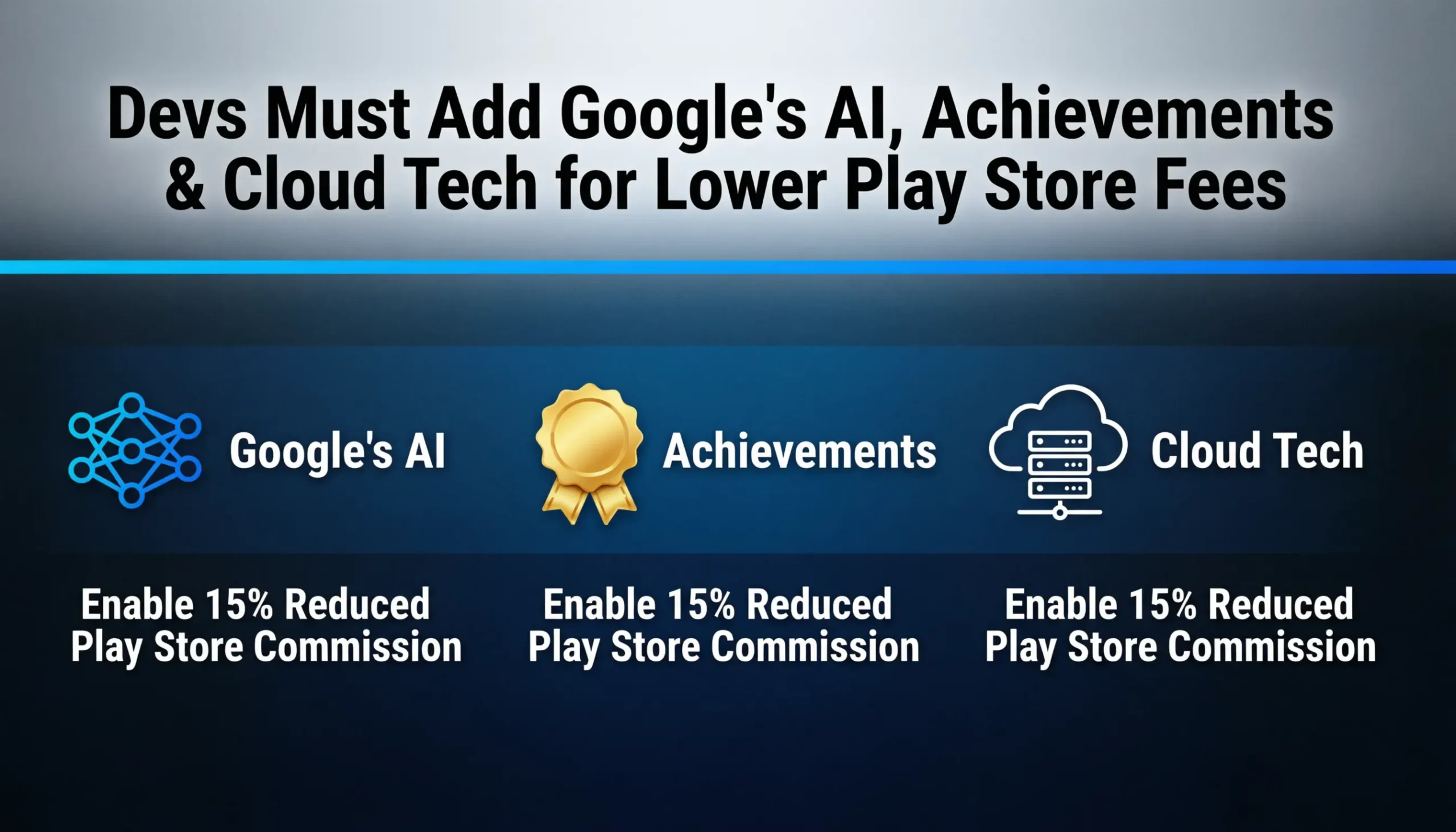
Google Play Store lower fees for developers are now real — but there are strings attached. Here's exactly what you need to integrate to qualify for 15%. Read on!
So Google finally gave us the full picture this week — and yeah, those Google Play Store lower fees for developers are real. But getting them? That’s a whole different story. There’s a checklist, there are deadlines, and honestly, some of it is going to catch a lot of devs off guard.
Quick bit of context if you’ve been off the grid: on March 4, 2026, Google and Epic Games officially ended their multi-year legal war. Part of the settlement means Fortnite is coming back to Google Play globally — and Google is completely overhauling how it charges developers. The 30% era is over.
But here’s the thing. The headline numbers are only part of the story. At GDC 2026 this week, Google spelled out exactly what developers need to do to access the best rates — and it goes way beyond just signing up. I’ve been digging through every announcement, the official blog posts, and the Play Console docs so you don’t have to. Here’s everything you need to know.
Let’s start with the actual fee structure, because there’s been a lot of confusion in the community about what these numbers really mean in practice.
As confirmed in Google’s official announcement on March 4, the standard IAP service fee is dropping from 30% to 20% for new installs. That applies to everyone, no strings attached. If someone installs your app after the new structure launches in their region, you pay 20%. For existing installs (people who already have your app), the 20% rate also applies going forward.
Subscriptions get an even bigger break — those drop all the way down to 10%. That’s massive for subscription-based games and apps.
Then there’s the billing fee. If you use Google Play’s own billing system, you’ll also pay a separate 5% in the US, UK, and European Economic Area. In other markets, that rate varies and will likely be higher. So in practice, many devs in Western markets are looking at 25% total (20% service + 5% billing) — still better than 30%, but not the clean break some people assumed.
Here’s the quick breakdown:
And if you want to hit that 15% rate? That’s where the Level Up program comes in — and that’s where things get interesting.
Okay, so this is the part that’s been causing the most noise in dev communities. To qualify for that extra 5% reduction — bringing your rate from 20% down to 15% on new installs — you need to join the Google Play Games Level Up program. And Level Up has requirements. Requirements are getting stricter as the year goes on.
I’ve been following the Level Up program since it was first announced back in September 2025, and honestly, the integration requirements have always been part of the deal. But now that there’s real money on the line — not just promotional perks — the stakes feel a lot higher.
Google confirmed at GDC this week that the program is now directly tied to the fee structure, and they’ve published a phased milestone schedule on the official Play Console page. Let me walk you through it.
By July 2026, you’ll need two things to live in your game to stay enrolled in Level Up and qualify for the lower rate:
The good news is you can start testing Sidekick today. Google has added a toggle in Play Console under Testing > Advanced Settings that lets you automatically add Sidekick to new app bundles. They’re actively encouraging devs to get ahead of the July deadline rather than scramble for it.
Four months after the July deadline, you’ll also need to have Google’s cloud save system implemented. This enables players to sync their progress across devices — so if someone switches from their phone to a tablet or PC, their save data comes with them.
From a player experience standpoint, this is honestly one of the best requirements on the list. I’ve been frustrated by mobile games that don’t support cross-device saves for years. It’s table stakes on console and PC — mobile should be no different.
But it does add backend complexity, especially for games that were built without cloud save in mind from the start. Factor in the development and testing time, and November isn’t as far away as it sounds.
Let’s zoom in on Play Games Sidekick, because it’s clearly the centerpiece of Google’s push here — and also the most debated part of the Level Up requirements. It’s one of the more ambitious Google AI tools for Android developers that’s been shipped in a while.
Here’s how it works in practice: Sidekick is an in-game overlay, meaning it sits on top of your game without pulling players out of it. Players can access it while actively playing to check their achievements, see rewards, view streaks, use Play Points coupons, and — this is the AI part — get Gemini-generated Game Tips based on their actual play activity.
Google also announced at GDC that Gemini Live integration is coming for Sidekick Early Access Partners. That means players will eventually be able to share their screen in real time and get live AI coaching. If that actually works well, it’s genuinely impressive. The jury’s still out on execution, though.
As of this week, Sidekick is live in 90+ games. Google plans to expand it to all Level Up titles later in 2026. The Play Games Services network has reached 600 million monthly active users, so the reach is there.
In my opinion? Sidekick has real potential as a player feature. The AI tips angle is the kind of thing that used to require a third-party wiki or a YouTube walkthrough. Having it built into the game natively is a genuinely useful upgrade for players.
But I’d be dishonest if I didn’t acknowledge what’s also happening here: Google is using the fee reduction as leverage to get developers to do the heavy lifting on their AI rollout. Requiring mandatory AI integration as a condition of better economics is a bold move — and not everyone in the dev community is thrilled about it.
Not everything from this week’s announcements comes with requirements. Google also dropped a bunch of Play Store updates that are just… good news for everyone:
The paid games library is also expanding — Google specifically called out Moonlight Peaks, Sledding Game, 9 Kings, Potion Craft, and Low-Budget Repairs as upcoming titles. Premium mobile gaming is clearly getting a serious push in 2026.
This is important because the rollout is phased — not everyone gets these fee changes at the same time. Here’s the confirmed schedule as per Google’s official announcement:
The ‘new install’ threshold also matters here: an install counts as ‘new’ if it happens on or after the date the new fee structure launches in that region. So if you’re in the US, anyone who installs your app after June 30 is a new install under the new rates. Google will use the time of first install from Play to determine this.
I want to spend a second on the bigger picture here, because the context matters. This whole restructuring stems from a federal jury ruling in 2023 that declared Google’s Play Store practices an illegal monopoly. Google and Epic have now settled — and the deal reportedly includes an $800 million joint partnership for product development on top of these policy changes.
Epic CEO Tim Sweeney called it the moment Android becomes a ‘truly open platform.’ Fortnite will be returning to Google Play globally — not just the US — as part of the deal. And Google has filed the new policy framework with US District Judge James Donato for review, with a hearing scheduled for April 9, 2026. Pending that approval, the June 30 US/UK/EEA deadline holds.
The bottom line is that this isn’t just a business policy shift — it’s the direct result of years of regulatory and legal pressure. And it’s worth keeping an eye on that April 9 hearing, because until the judge signs off, nothing is fully locked in for the US market.
SOURCES:
• Android Developers Blog (Mar 4, 2026): A new era for choice and openness
• Android Developers Blog (Mar 12, 2026): Level Up: Test Sidekick and prepare for upcoming milestones
• Google Play Console — Level Up program page: play.google.com/console/about/levelup
• Android Developers — Play Games Sidekick (beta): developer.android.com/games/pgs/play-games-sidekick
• Google Play Console Help — Understanding lower service fees: support.google.com/googleplay/android-developer/answer/16954621
• TechCrunch (Mar 4, 2026): Google settles with Epic Games, drops Play Store commissions to 20%
• TechCrunch (Mar 11, 2026): Google Play adding paid games, game trials, community posts, and more
• Engadget (Mar 4, 2026): Google ends its 30 percent app store fee and welcomes third-party stores
• 9to5Google (Mar 4, 2026): Google vs Epic dispute ends — registered app stores, lower fees roll out this year
• MobileGamer.biz (Mar 12, 2026): Devs must add Google’s AI, achievements, and cloud tech to get lower Play Store fees
• Mobile Marketing Reads (Mar 11, 2026): Google introduces Game Trials and AI Sidekick as Play expands toward cross-platform gaming