Physical Address
304 North Cardinal St.
Dorchester Center, MA 02124
Physical Address
304 North Cardinal St.
Dorchester Center, MA 02124

Find Gear. Build Dreams. Game On.
Find Gear. Build Dreams. Game On.
Let’s be honest — nobody wants to lose a match because their phone decided to drop frames at the worst possible moment. If you’re tired of lag, stuttering, and choppy gameplay, you’re in the right place.
This guide is all about how to boost gaming performance on Android in a way that actually works — no root required, no risky apps, just practical steps you can do right now. Whether you’re on a flagship or a budget phone, there’s something here for you.
I’ve been messing around with Android optimization for years, and I can tell you — most guides online are either outdated or full of tips that don’t actually do much. This one is different. Let’s get into it.
Before you start tweaking anything, it helps to understand what’s actually causing the problem. Most Android gaming issues come down to three things: limited RAM, thermal throttling, and background apps hogging resources.
The good news? Most of these are fixable without any special tools. The best settings for low-end Android phones’ gaming usually aren’t about installing anything new — they’re about removing what’s getting in the way.
Here’s what tends to kill gaming performance the most:
Once you identify the culprit, fixing it gets a lot easier. The sections below cover each one in detail.
Honestly, the fundamentals haven’t changed much — but in 2026, there are some newer tricks that make a real difference, especially with how Android 14 and 15 handle background processes and GPU scheduling.
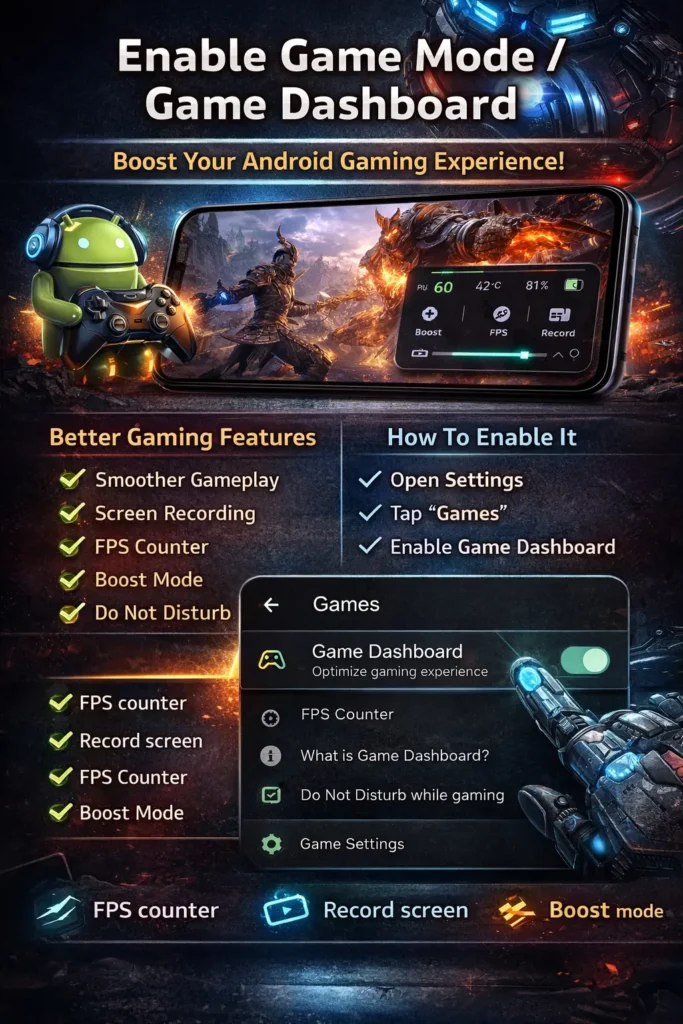
Most Android phones in 2026 have some form of built-in Game Mode. On Samsung, it’s called Game Booster, on Xiaomi, it’s Game Turbo, and stock Android has the Game Dashboard. Enable it.
These modes block notifications, restrict background apps, and sometimes give the game priority CPU access. It’s one of the easiest ways to optimize your Android phone for gaming performance with literally one tap.
This sounds basic, but it makes a big difference — especially on phones with 4GB or 6GB of RAM. Go to your recent apps and close everything. Then go to Settings → Battery and restrict background activity for apps you don’t need running.
In my opinion, this is the single most effective free fix for how to reduce lag in Android games without root. You’re not adding performance — you’re freeing up what was already being wasted.
This one trips up so many people. Battery saver mode intentionally caps your CPU and GPU speed to save power. If it’s on while you’re gaming, you’re literally playing at reduced performance on purpose.
Disable it before every session. If you’re worried about battery, plug in while playing instead. Also, check if your phone has a Performance Mode in battery settings — that’s the opposite of battery saver and can noticeably boost FPS.
Android slows down noticeably when the internal storage is too full. The rule of thumb: keep at least 10–15% free at all times. Delete unused apps, clear cached data, and move photos/videos to cloud storage or an SD card if you have one.
I’ve seen phones gain back buttery smooth performance just from clearing 3–4GB of junk files. It’s underrated.
This isn’t about giving up — it’s about playing smart. For competitive games, lower graphics + stable high FPS always beats beautiful graphics with dropped frames. Lower shadow quality, reduce render distance, and disable anti-aliasing first. These have the biggest impact on performance.
For the best settings for low-end Android phones’ gaming, set everything to Low or Medium, lock your frame rate to 60, and disable any HDR or Ultra HD options. You’ll be surprised how much smoother games run.
Okay, so we’ve covered the basics. Now let’s talk about the slightly more advanced stuff that can actually push your FPS higher — not just stabilize it.
As of March 2026, these are the methods I’ve seen work consistently across different devices and games:
Use a DNS changer for online games. Switching to Google DNS (8.8.8.8) or Cloudflare (1.1.1.1) can reduce ping and make online games feel more responsive. It doesn’t increase raw FPS but cuts the lag that feels like FPS drops.
Enable Developer Options for GPU tweaks. Go to Settings → About Phone → tap Build Number 7 times to unlock Developer Options. Inside, enable “Force GPU Rendering” and set the background process limit to “At most 2 processes.” These two alone can make a noticeable difference.
Wipe your system cache partition. After major Android updates, old cache files clash with new system files. Wiping the cache partition via Recovery Mode clears this out without touching your data. I’ve seen this fix post-update FPS drops instantly.
Use Lite versions of apps where possible. If you have Facebook, Messenger, or other heavy apps installed, swap them for Lite versions. They consume way less RAM in the background, leaving more headroom for your game.
Here’s a breakdown of common optimization methods — how much effort they take versus how much of a difference they actually make:
| Method | Effort | FPS Impact | Safe Without Root? |
| Kill background apps | Low | High | Yes |
| Disable battery saver | Low | High | Yes |
| Enable Game Mode | Low | Medium–High | Yes |
| Lower in-game graphics | Low | Very High | Yes |
| Free up storage (10%+) | Medium | Medium | Yes |
| Wipe system cache partition | Medium | Medium–High | Yes |
| Force GPU rendering (Dev Options) | Medium | Medium | Yes |
| DNS changer (online games) | Low | Low–Medium | Yes |
| Game booster app (3rd party) | Low | Low–Medium | Yes |
| Custom kernel / ROM | High | Very High | Requires root |
Honestly, if you just do the top four on this list, you’ll already feel a solid difference. The rest are bonuses.
Does clearing the cache actually improve gaming on Android?
Yes, especially after a major OS update. The system cache can get corrupted or outdated, which causes stuttering and slowdowns. Wiping it via Recovery Mode takes about 5 minutes and won’t delete any of your data.
How do I reduce lag in Android games without rooting my phone?
The most effective no-root methods are: closing background apps before playing, disabling battery saver, enabling your phone’s built-in Game Mode, and lowering in-game graphics settings. These alone fix most lag issues.
Does more RAM mean better gaming performance on Android?
More RAM helps, but it’s not the only factor. A phone with 6GB of RAM that’s well-optimized will often outperform one with 8GB that’s running ten background apps. Managing what’s running matters as much as the hardware itself.
Can a third-party game booster app actually help?
Some can, some are basically useless. The built-in game modes from phone manufacturers (Samsung Game Booster, Xiaomi Game Turbo) are generally better than third-party options. If you want a third-party one, look for apps that close background processes rather than ones that claim to “boost RAM” with a single tap — those are mostly gimmicks.
What’s the best frame rate to target on a low-end Android phone?
Aim for a stable 60 FPS over an unstable 90. A locked 60 with no drops feels much better than 90 FPS that dips to 40 every few seconds. Set your in-game frame rate cap to 60 and focus on keeping it consistent.
Related Articles
Look, there’s no magic app or single setting that transforms a budget phone into a gaming powerhouse. But the combination of tips in this guide? That stuff genuinely works. I use most of these myself, and the difference is real.
The biggest mistake I see people make is downloading some sketchy “RAM booster” app and expecting miracles, while ignoring the basics like battery saver being on or storage being 95% full. Start simple. Fix the obvious stuff first. Then layer in the more advanced tweaks.
If you’re on a low-end device, managing expectations is part of it too — but you can absolutely get a smoother, more stable experience than what you have right now by following these steps.
What’s the biggest performance issue you’re dealing with on your phone right now? Drop it in the comments — I’d love to help you figure out what’s causing it!







[…] Boost Gaming Performance on Android (2026) […]
[…] Boost Gaming Performance on Android (2026): Increase FPS & Fix Lag Fast […]